How to Increase Trustpilot Reviews for Your eCommerce Store With TextYess
Increase Trustpilot reviews on autopilot with TextYess. Trigger personalized WhatsApp and on-site requests after every order — no manual follow-ups needed.
Increase Trustpilot reviews on autopilot with TextYess. Trigger personalized WhatsApp and on-site requests after every order — no manual follow-ups needed.

Trustpilot reviews influence purchase decisions, but most ecommerce brands struggle to collect them consistently. Email requests get buried, timing feels random, and the whole process depends on someone remembering to follow up.
Conversational commerce tools change this by automating personalized review requests through WhatsApp and on-site chat at the exact moments when customers are most likely to respond. This guide covers how to set up automated Trustpilot review collection using TextYess, including the best timing, channel selection, and step-by-step implementation.
The fastest way to increase Trustpilot reviews is to trigger automated, personalized messages through WhatsApp and on-site chat at the right moment in the customer journey. WhatsApp messages achieve open rates up to 98%, which makes them far more effective than email for collecting feedback. The timing matters: sending a review request 4 to 7 days after delivery, when the customer has used the product but the experience is still fresh, consistently produces the best response rates.
Trustpilot reviews shape buying decisions at the exact moment a shopper is deciding whether to trust your brand. A strong review profile builds confidence for first-time visitors who have never purchased from your store before.
Reviews also affect search visibility. Trustpilot pages often rank in Google results, so your star rating can appear before a shopper even reaches your website.
Social proof: builds confidence for first-time buyers unfamiliar with your brand — 71% of US consumers say a good Trustpilot score makes them more likely to buy from a brand
Search visibility: Trustpilot reviews appear in Google results alongside your brand name
Conversion lift: shoppers trust peer feedback over brand claims, especially for higher-priced items
Getting more reviews comes down to making the ask easy, timely, and personal.
Trustpilot integrates directly with Shopify, WooCommerce, and other platforms. Once connected, review invitations trigger automatically after order fulfillment. This removes the manual effort of remembering to ask and ensures every customer receives a request. The same principle applies to other revenue-driving flows like post-purchase upsell and cross-sell sequences — when the request is automated, it never gets skipped.
When a customer has just received helpful guidance from a support agent or an AI chatbot on your store, they are in a positive frame of mind. This is the ideal moment to ask for a review. The request feels natural rather than transactional.
Many customers intend to leave a review but forget. A follow-up message, spaced 5 to 7 days after the first request, can recover a significant portion of missed opportunities. The reminder works best when it references the specific product purchased — the same logic that makes WhatsApp drip campaigns outperform one-shot blasts.
Responding to reviews, both positive and negative, signals that the brand is actively listening. This visibility encourages future customers to share their experiences.
Timing determines whether a review request feels helpful or intrusive.
The customer has received and used the product. This is the highest-intent moment for a genuine review. Waiting too long risks the experience fading from memory.
A successfully resolved issue often creates stronger loyalty than a problem-free experience. Customers who felt heard are frequently willing to share that positive outcome — which is one reason automating WhatsApp customer support pays off twice: once in the resolution, and again in the review.
Loyal customers are more likely to leave reviews. A second or third purchase signals brand affinity, and repeat buyers often have more detailed feedback to share.
Email review requests typically achieve open rates between 15% and 25%. WhatsApp messages, by contrast, are opened by the vast majority of recipients, often within minutes — 80% within just five minutes.
Channel | Open Rate | Response Speed | Personalization Potential |
|---|---|---|---|
15–25% | Hours to days | Limited | |
90–98% | Minutes | High (uses order data) | |
On-site chat | High | Real-time | High (context-aware) |
WhatsApp messages feel personal rather than promotional. Because customers have opted in to receive messages, engagement tends to be high. The conversational format also allows customers to ask questions before clicking through to leave a review. For a deeper look at the full WhatsApp playbook, see the step-by-step guide to WhatsApp marketing campaigns for ecommerce.
Chat agents, whether human or AI, can ask for reviews at the end of a positive interaction. The request happens in context, immediately after the customer has received value.
Conversational commerce refers to using messaging and chat channels to engage customers in real-time interactions. When applied to review collection, conversational tools remove manual effort while maintaining personalization.
Trigger-based automation: sends requests based on order status, delivery confirmation, or support resolution
Personalization at scale: uses customer name, product purchased, and order details in every message
Multi-channel orchestration: coordinates messages across WhatsApp and on-site chat from a single platform
The advantage over traditional email sequences is both reach and relevance. Conversational tools adapt the message based on what the customer just experienced, rather than sending the same generic request to everyone.
TextYess is an AI-first conversational platform built specifically for ecommerce. It connects directly to your store, pulling in product data, order history, and customer profiles to power personalized interactions across every channel.
TextYess turns review collection into a fully automated WhatsApp flow. The moment a delivery is confirmed, a personalized message goes out with the customer's name, the specific product they purchased, and a direct link to leave a Trustpilot review. The flow doesn't stop at one message — it includes:
Trigger logic: fires on delivery confirmation, support ticket resolution, second purchase, or any custom Shopify event
Conditional branching: if the customer's reply signals a problem, the flow re-routes them to support instead of pushing the review link
Follow-up reminders: an automatic nudge 5 to 7 days later for customers who opened the message but didn't review
Sentiment-aware throttling: customers who recently complained or returned an order are filtered out before the request is sent
Quiet hours and rate limits: messages respect time zones and Trustpilot's invitation rules
Because the flow lives inside the same platform as your other post-purchase, upsell, and cross-sell automations, reviews stop being a one-off project and become part of the customer journey.
Automated flows handle every new order going forward, but most stores also have months — sometimes years — of past customers who were never asked for a review. TextYess's WhatsApp campaign builder closes that gap with one-off broadcasts you can launch in minutes:
Segment the audience: pull a list of customers who purchased in the last 30, 60, or 90 days and never left a review, using TextYess's built-in segmentation for WhatsApp campaigns
Filter by satisfaction signals: exclude anyone with an open ticket, recent refund, or negative reply
Personalize at scale: dynamic fields pull in the customer's name, their most-purchased product, and a tailored review link
A/B test the ask: run two message variants against a slice of the segment, then send the winner to the rest
Time the send: schedule the broadcast for the highest-response window for each region
These campaigns are also useful around moments where social proof matters most — Black Friday prep, a new product launch, or a push to climb in a specific category on Trustpilot.
The on-site AI agent can detect positive interactions: a completed purchase, a resolved question, or a successful product recommendation. At these moments, the agent prompts the customer to share their experience on Trustpilot — capturing the review while the positive sentiment is still fresh.
Every review request sent through TextYess pulls from the customer's actual order and profile. The message references the specific product, uses the customer's name, and can acknowledge their purchase history. Personalization at this level increases response rates compared to generic requests.
Getting started takes minutes rather than days.
Create your TextYess account, link your store and upload your segments.
Define when review requests are sent: after delivery, after a positive chat interaction, or after a support resolution. Each trigger can be customized and combined with conditional branching, so dissatisfied customers are routed to support and only happy ones reach the review step.
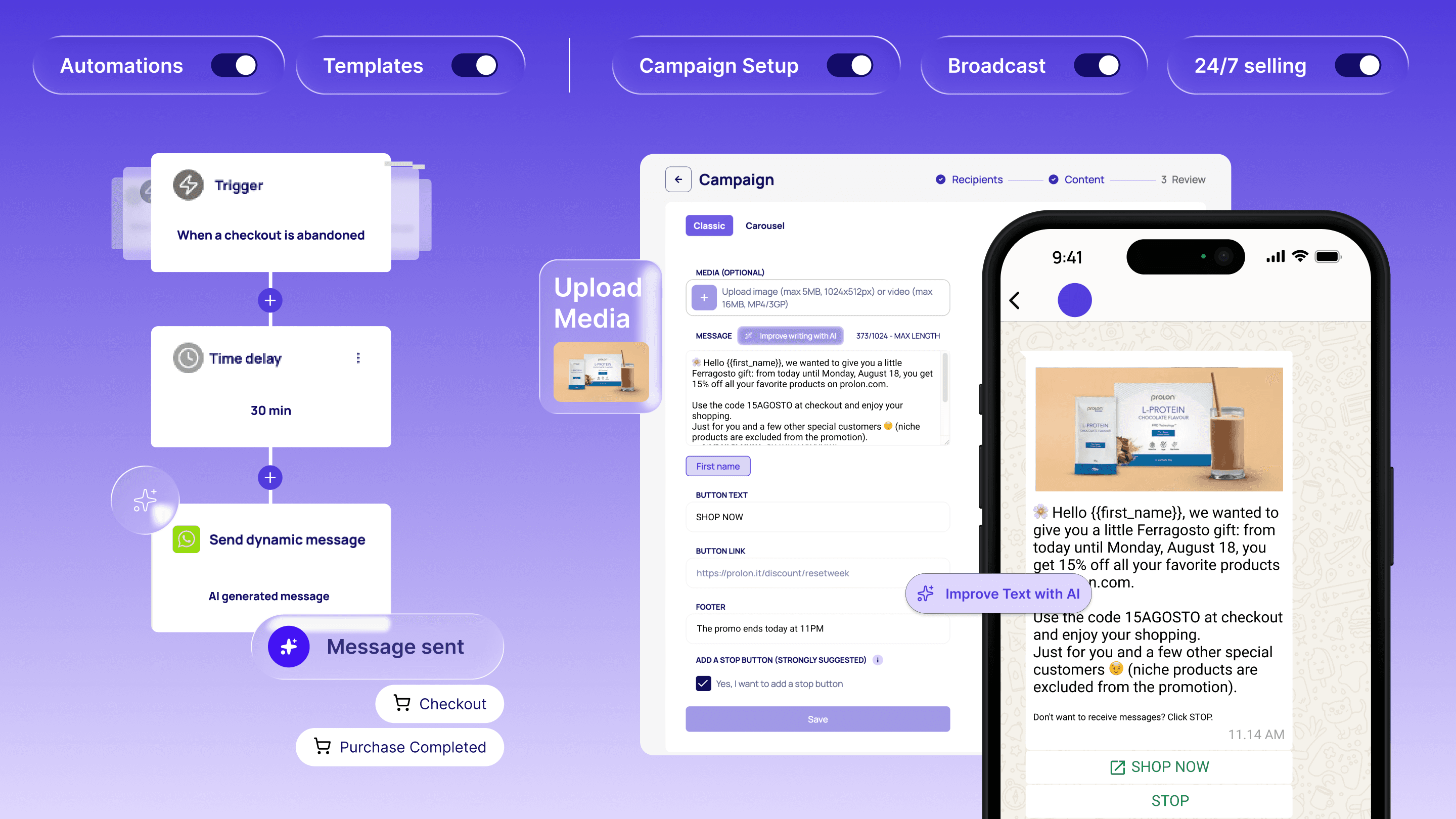
Customize the message templates to match your brand tone. Include dynamic fields for customer name, product name, and order details. Set up a reminder for customers who received the first message but haven't yet left a review.
Before relying only on the always-on flow, run a one-time WhatsApp campaign to past customers who never received a review request. Segment by purchase recency, exclude unhappy customers, and send a personalized invitation. This single campaign often produces more reviews than the first month of new automated flows combined.
Activate the automations and track results in the TextYess dashboard. Monitor review volume, response rates, and TrustScore changes over time.
Tracking the right metrics reveals whether your review collection strategy is working.
Review volume: total reviews collected per week or month
Response rate: percentage of customers who leave a review after receiving a request
TrustScore trend: directional movement over time, not just the current number
Channel attribution: which channel (WhatsApp or on-site chat) drives the most reviews
Flow vs. campaign mix: how many reviews come from always-on flows versus ad hoc campaigns
TextYess provides analytics that connect review outcomes to specific campaigns and triggers. This makes it possible to identify which moments and messages generate the best results, then optimize accordingly.
Review collection does not have to be a manual, inconsistent process. With conversational commerce tools, every positive customer interaction becomes an opportunity to build your Trustpilot profile.
TextYess makes this practical by automating personalized review requests across WhatsApp and on-site chat, then layering ad hoc campaigns on top to re-engage past customers — all from a single platform that connects directly to your ecommerce stack. The result is a steady flow of reviews that improves your TrustScore and builds social proof over time.
How many review requests can you send per customer on Trustpilot?
Are WhatsApp review invitations compliant with Trustpilot guidelines?
What response rate can WhatsApp review requests achieve compared to email?
Can AI agents detect unhappy customers before asking for a Trustpilot review?
Can I send review requests to customers who purchased months ago?