Growing Your Ecommerce WhatsApp List: Strategies That Actually Work
Grow your WhatsApp subscriber list for ecommerce with proven tactics—from website widgets and Click-to-WhatsApp ads to QR codes and cross-channel opt-ins.
Grow your WhatsApp subscriber list for ecommerce with proven tactics—from website widgets and Click-to-WhatsApp ads to QR codes and cross-channel opt-ins.
Most ecommerce brands treat WhatsApp as a support channel: a place to answer questions after the sale. The brands growing fastest have figured out something different: a well-built subscriber list turns WhatsApp into a revenue engine that outperforms email and SMS combined.
The challenge isn't whether WhatsApp works for ecommerce, it's getting customers to opt in. This guide covers the specific tactics, from website widgets to Click-to-WhatsApp ads to QR codes, that consistently grow subscriber lists for online brands.
Growing a WhatsApp subscriber list for ecommerce comes down to offering clear value: exclusive discounts, early access to sales, or VIP perks that give customers a reason to opt in. The most effective approaches combine Click-to-WhatsApp ads, website popups, and chat widgets that replace traditional support forms with direct conversation starters.
A WhatsApp subscriber list is a database of customers who have explicitly agreed to receive messages from your brand on WhatsApp. Unlike email lists, subscribers here are reachable on a channel they check 23–25 times per week, often within minutes of receiving a message.
WhatsApp messages see open rates above 90%, compared to email's typical 20-25%. For EU-focused brands especially, WhatsApp dominates as the default messaging app across most markets, exceeding 94% penetration in DACH alone.
Global reach: WhatsApp has over 2 billion users worldwide, with particularly strong adoption across Europe, Latin America, and Asia
Higher engagement: Messages feel personal rather than promotional, leading to response rates that outperform traditional channels
Direct conversations: Two-way dialogue means customers can ask questions, get recommendations, and complete purchases without leaving the chat
Before diving into tactics, it helps to understand the two ways brands can operate on WhatsApp. The WhatsApp Business App works well for small operations—it's free, easy to set up, and handles basic messaging. However, it limits broadcast lists to 256 contacts and offers minimal automation.
The WhatsApp Business API unlocks everything larger ecommerce brands typically want: unlimited broadcasts, full automation through AI agents, and integration with your existing tech stack. Most brands serious about list growth eventually move to the API, often through platforms that handle the technical complexity.
Feature | WhatsApp Business App | WhatsApp Business API |
|---|---|---|
Best for | Small businesses, low volume | Growing brands, high volume |
Automation | Limited quick replies | Full automation, AI agents |
Broadcast limits | 256 contacts | Unlimited with templates |
Integration | Manual | Connects to ecommerce stack |
Cost | Free | Platform fees apply |
Your website is typically the most reliable source of new WhatsApp subscribers because visitors are already engaged with your brand. The key is making opt-in opportunities visible without being intrusive.
A chat widget is a small button, usually in the bottom corner of your site, that opens a WhatsApp conversation when clicked. Placing widgets on product pages, your homepage, and the cart page catches shoppers at different stages of their journey. When someone clicks and sends that first message, you've captured their opt-in.
The best way to get your WhatsApp bubble? We're biased, but it's most definitely TextYess, so you can attach automations and convert conversations into revenue right away.
Timed popups and exit-intent triggers can prompt visitors to join your WhatsApp list before they leave. The most effective popups offer something immediate—a 10% discount, free shipping, or early access—in exchange for a phone number with explicit WhatsApp consent.
Keep the form short: phone number and a checkbox confirming they want WhatsApp updates.
Adding a WhatsApp opt-in field during checkout captures high-intent buyers who already trust your brand enough to purchase. A simple checkbox like "Get order updates and exclusive offers on WhatsApp" works well here. Subscribers acquired at checkout tend to be more engaged because they've already converted once.
For campaigns, a single-purpose landing page focused entirely on WhatsApp sign-up can drive strong conversion rates. Include a clear value proposition, a wa.me link (WhatsApp's direct chat link format), and minimal distractions. Landing pages like this work particularly well as destinations for paid ads or social media campaigns.
Click-to-WhatsApp ads (CTWA) are Meta ads that open a WhatsApp conversation directly when someone taps them. Instead of sending traffic to a landing page, you're starting a conversation—and capturing the subscriber in the process.
Running CTWA campaigns on Facebook and Instagram is a proven way to generate ecommerce leads directly in users' feeds. When someone taps the ad, WhatsApp opens with a pre-filled message, and once they send it, you have their number and consent. The user flow feels seamless because there's no form to fill out.
The strongest CTWA campaigns target warm audiences rather than cold traffic. Retargeting website visitors, past purchasers, or email subscribers tends to produce higher opt-in rates and better-quality subscribers.
Target warm audiences: Retarget website visitors and past purchasers who already know your brand
Clear value proposition: State exactly what subscribers will receive—exclusive deals, early access, personalized support
Mobile-first creative: Design for tap-to-chat behavior with prominent CTA buttons and minimal text
Your existing audience across other channels represents an untapped source of WhatsApp subscribers. The goal is to migrate engaged contacts to a channel where you can reach them more reliably.
Adding a WhatsApp CTA to your email footer creates a passive growth channel. For faster results, send a dedicated email inviting subscribers to join your WhatsApp list with a specific incentive—something they won't get via email alone.
Your Instagram bio, story swipe-ups, and pinned posts can all link directly to WhatsApp using wa.me links. Framing WhatsApp as an exclusive channel—"DM us on WhatsApp for VIP access"—performs better than a generic "Contact us" prompt.
If you already have an SMS list, inviting subscribers to join WhatsApp makes sense. WhatsApp offers richer experiences—images, product carousels, interactive buttons—that SMS can't match. Position it as an upgrade rather than a replacement.
QR codes bridge physical and digital touchpoints by letting customers scan and instantly open a WhatsApp conversation. For brands with any offline presence, QR codes are often an overlooked growth channel.
Including a QR code on packaging, thank-you cards, or package inserts catches customers at a moment of excitement—right when they've received their order. A clear CTA like "Scan for exclusive offers and easy reorders" gives them a reason to act.
Retail displays, pop-up events, and trade show materials can all feature QR codes linking to WhatsApp. QR codes work particularly well for brands that want to continue the conversation after an in-person interaction.
Digital receipts, invoices, and catalogs offer additional opt-in opportunities. Even a small QR code with "Get support and updates on WhatsApp" can drive steady subscriber growth over time.
Getting the mechanics right is only half the equation. The messaging and psychology behind your opt-in offers determine how many visitors actually subscribe.
Customers are protective of their WhatsApp inbox—it's personal space. The incentive you offer determines whether they'll let your brand in.
Exclusive discounts: First-purchase or subscriber-only offers that aren't available elsewhere
Early access: New product launches or sales before the general public
Free shipping: Threshold-free delivery for WhatsApp subscribers
Content or guides: Styling tips, how-to content, or product guides relevant to your category
Stating upfront what subscribers will receive—and how often—builds trust and reduces opt-outs later. Something like "Get 2-3 messages per week with exclusive deals and order updates" sets appropriate expectations. Vague promises lead to unsubscribes when reality doesn't match assumptions.
Framing WhatsApp as VIP access rather than just another marketing channel changes how customers perceive the opt-in. "Join our WhatsApp insiders" feels different from "Sign up for WhatsApp updates." The conversational, personal nature of the channel supports VIP positioning naturally.
For EU-focused brands, compliance isn't optional—it's foundational. WhatsApp requires explicit opt-in consent before you can send marketing messages, and GDPR adds additional requirements.
Consent collection for WhatsApp marketing follows the same principles as other channels, but the personal nature of messaging makes compliance even more important.
Explicit consent: Checkboxes cannot be pre-checked; customers have to actively opt in
Record keeping: Store proof of opt-in with timestamp and source for each subscriber
Privacy policy: Clearly disclose how you'll use WhatsApp data and what messages subscribers will receive
WhatsApp policy requires honoring opt-out requests immediately. Standard keywords like "STOP" or "UNSUBSCRIBE" trigger automatic removal from your list. Making opt-out easy actually improves list quality—you want engaged subscribers, not reluctant ones.
Building a subscriber list is step one. Keeping subscribers engaged, and converting them into buyers, is where AI agents become valuable.
The moment someone subscribes is your highest-engagement window. An automated welcome message that delivers immediate value (the promised discount code, a product recommendation, or a quick introduction) sets the tone for the relationship. AI agents can personalize welcome messages based on where the subscriber opted in.
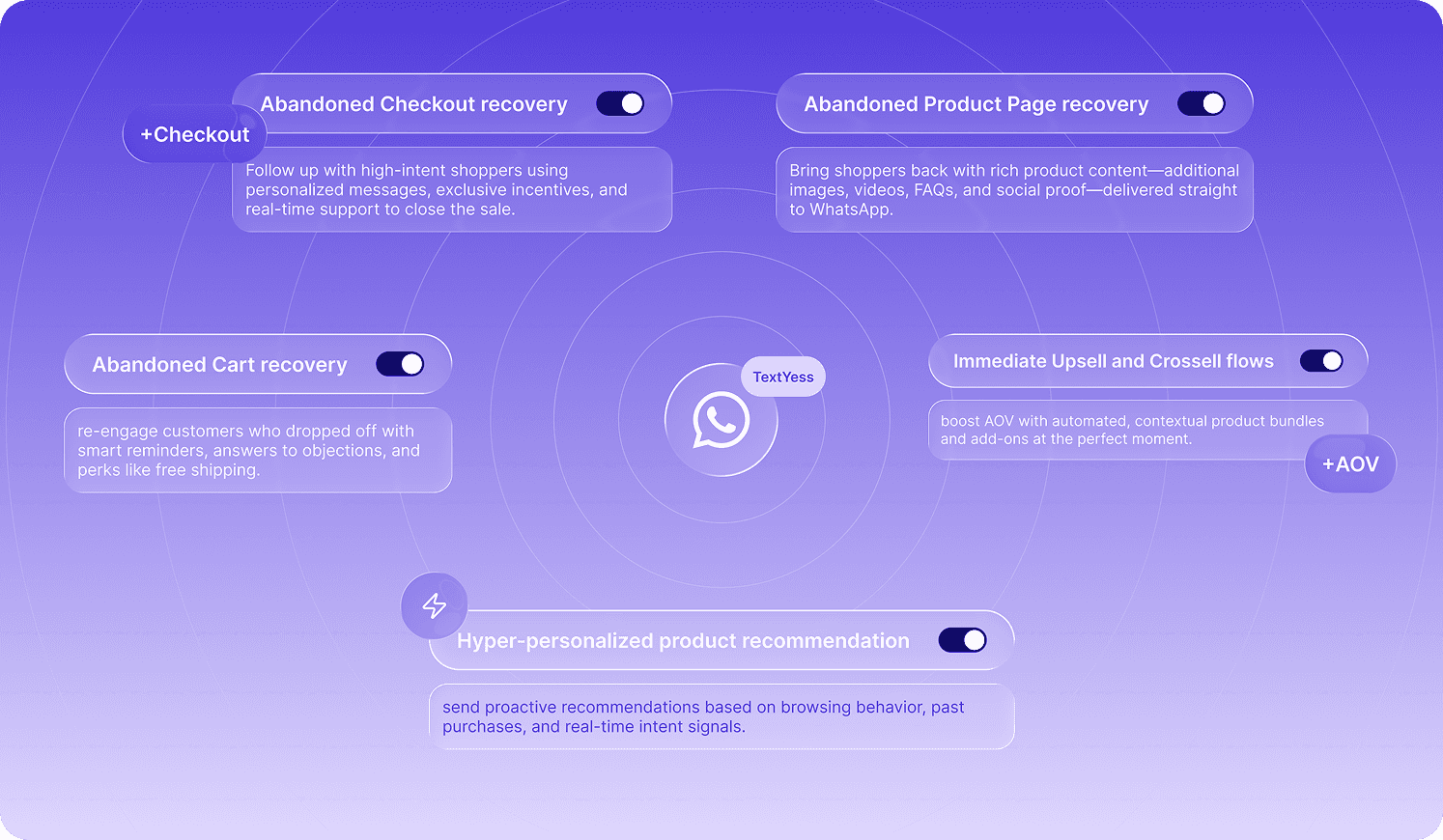
Some of the most effective list-building happens through proactive outreach. With an average cart abandonment rate of 70.19%, abandoned checkout recovery messages, back-in-stock alerts, and order updates all create natural opportunities to capture opt-ins from customers who haven't yet subscribed. Platforms like TextYess handle proactive triggers automatically, turning transactional moments into list-building opportunities.
A subscriber list is only valuable if it drives sales. The real payoff comes from personalized conversations that guide shoppers toward purchases—answering questions, recommending products, and removing friction at every step.
For brands ready to turn WhatsApp into a measurable sales channel, the combination of strategic list building and AI-powered engagement creates a flywheel: more subscribers lead to more conversations, which lead to more revenue, which funds more acquisition.
Building a subscriber list is only the first step: what happens after the opt-in determines whether WhatsApp becomes a real revenue channel or just another inbox.
TextYess is built specifically for this moment: once a shopper subscribes, the platform's AI agent takes over, delivering personalized welcome messages based on opt-in source, triggering abandoned checkout recovery automatically, and managing every follow-up conversation without manual intervention. Because TextYess connects directly to your eCommerce stack, it pulls real order, product, and customer data to make each message feel relevant rather than generic. For EU brands, multi-language support means those conversations stay local regardless of market. Setup requires no code — connect your store, configure your AI Shopping Agent's goals and tone, and you're live within minutes.
What is the 24-hour rule on WhatsApp Business?
Can I import my existing email or SMS list directly to WhatsApp?
How quickly can an ecommerce brand expect to grow a WhatsApp subscriber list?
What metrics help measure WhatsApp subscriber list growth?
How do I re-engage WhatsApp subscribers who have gone inactive?